

Let’s be real: most new trucks these days are in an arms race over who can cram the biggest screen into the dash. Then there’s the Slate Truck — a $24,950 electric pickup that ships with no paint and no infotainment screen at all. And here’s the part that should make you pay attention before anyone puts down a deposit: Slate switched the truck’s entire battery chemistry just weeks before opening preorders, months before the first one ever reaches a driveway.

Photo: Slate Auto
When Slate first showed the truck off, buyers were promised a choice — a 150-mile base battery or an upgraded 84.3-kWh pack good for 240 miles. By the time Slate revealed final pricing on June 24, that plan was gone, replaced by a single 65-kWh lithium-iron-phosphate pack rated for 205 miles. The company swapped from nickel-manganese-cobalt cells to LFP cells sourced from China’s Gotion, assembled at a factory in Illinois. The short version: LFP is roughly 40% cheaper to build, and once the $7,500 federal EV tax credit disappeared, there was no reason left to pay more for the fancier chemistry.
You lose the long-range option entirely, but the base truck actually goes farther than originally promised — 205 miles instead of 150. A truck that hasn’t put a single unit in a customer’s driveway already changed its battery once, and that’s worth knowing before you hand over a deposit. I’ve seen enough startups in the automotive space promise one thing at reveal and deliver another at launch — the difference here is Slate’s change actually helped buyers instead of quietly walking something back.
Here’s why I’m not writing this truck off, though. Slate isn’t trying to be a finished product — it’s trying to be a blank canvas, and that’s the most interesting thing about it. The base truck comes in exactly one color from the factory: gray primer. No infotainment screen. Hand-crank windows. Physical HVAC knobs. Slate is betting the entire vehicle strategy on a marketplace of more than 200 accessories instead of a trim ladder — 17-inch and 20-inch wheel sets at $1,399.99, Kenda off-road tires at $1,099.99, a 2-inch lift kit, a bolt-in 400-watt stereo for the guys who skipped the screen, and 50 factory-designed wrap colors starting at $499.99 that you can install yourself in the driveway. This isn’t a truck you buy finished — it’s a truck you finish yourself, and that’s the whole point.
Picture it two ways. Slammed and clean — deep-dish chrome wheels, a gloss black wrap, tucked tight to the fenders, the kind of build that looks right parked under neon outside a coffee shop at midnight.

Or flip it completely — lifted, wrapped in a warm gray-and-rust retro stripe package, a roof light bar and rack up top, all-terrain tires, and a spare mounted in the bed for whatever trail you’re pointed at.
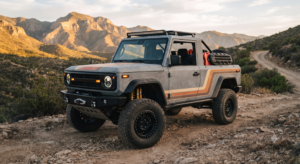
Same $24,950 truck, two completely different guys. That’s the entire pitch, and I don’t think Slate could’ve engineered a better proof of concept if they tried.
Bottom line: tick every box on Slate’s accessories list and you can push a $24,950 truck past $45,000, so the blank canvas isn’t free — but you’re the one deciding where every dollar goes instead of a manufacturer deciding for you. That’s still the cheapest new truck in America even loaded up, and it’s the only one on the market designed from day one to be built twice — once at the factory, once by you. Deliveries start late this year. I’ll believe the marketplace lives up to the hype when I see one built up in person, but I like the bet Slate is making.
Which build wins for you — slammed and clean, or lifted and ready for anything? Drop your take in the comments.